Cartier / Watch journal
Cartier Story
Cartier’s watch identity is inseparable from shape. Santos, Tank and bracelet-led designs reveal why proportion matters as much as mechanism.
Milestones that explain the collection
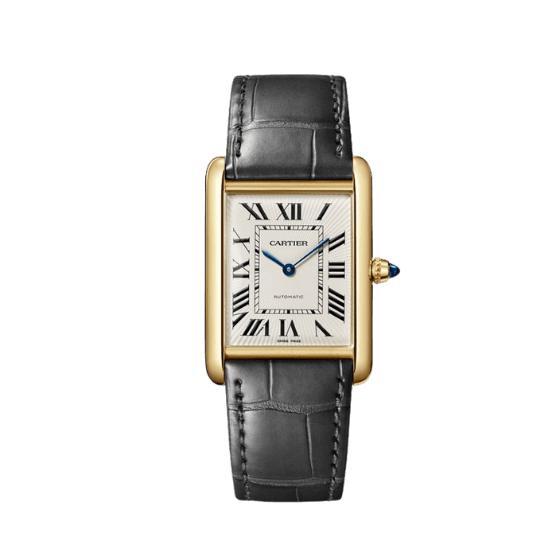
Cartier traces the Santos design to 1904 and the Tank to 1917. Their importance lies in case shape and proportion, not simply in adding complications. A rectangular or square watch should therefore be compared by length, width and wrist coverage rather than by a round-watch diameter alone.
Sources: Cartier
A history read through shape and proportion
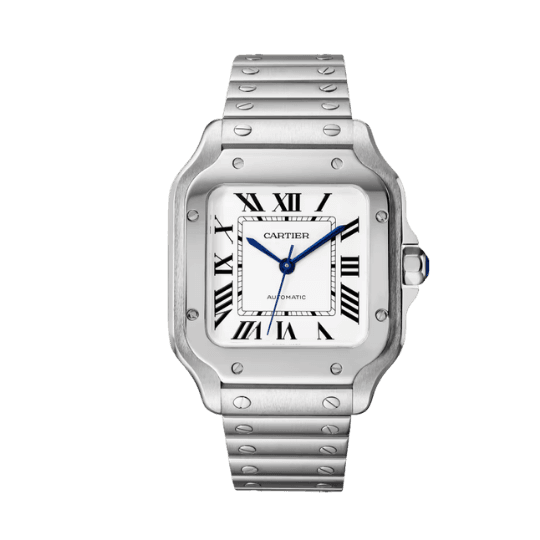
The Santos and Tank establish two different ways of making a watch recognisable without relying on a round case. Santos places emphasis on a square architectural outline; Tank uses the relationship between a rectangular dial and its elongated sides. Looking at these forms explains why the usual comparison by diameter can be unhelpful. Width, length, thickness and how the strap or bracelet leaves the case all contribute to the impression. A smaller watch can retain a strong identity without adding dial detail.
This emphasis on design makes the relationship between watch and jewellery important rather than secondary. A bracelet-led Panthère asks a different wearing question from a Tank on a leather strap, while a Ballon Bleu introduces another case outline. The useful historical lesson is continuity of proportion, not a requirement to choose a mechanical movement or a large size. Assess the exact version for what it is meant to look and feel like; then ask whether its condition preserves that effect.
Sources: Cartier
Read the history through the watch
A brand history is most useful when it helps explain the watch in front of you. Separate a collection’s first appearance from the production date of a particular reference. A familiar name can continue through major changes in construction, movement and proportions.
A modern heritage model may quote an older dial or case without reproducing its original mechanism or dimensions. That can be an advantage for everyday ownership. Conversely, a vintage watch may preserve period character while demanding more careful handling and specialist servicing. Neither is automatically the more authentic expression of your personal taste.
How this applies to Cartier
Compare Tank for a rectangular silhouette, Santos for a more architectural square form, Panthère for its bracelet-led jewellery character and Ballon Bleu for a rounder case. Select the exact size and movement after choosing the shape. A small quartz Cartier can be an intentional design choice, not an inferior substitute for a larger mechanical watch.
Put the information to work
Use the manufacturer’s chronology to establish context, then verify the actual reference, case and movement. Ask whether dial, hands and bracelet are period-correct, later manufacturer replacements or aftermarket parts. Provenance should describe the individual watch; an evocative story about the brand cannot substitute for it.
What to check on an individual watch
Look closely at polished case edges, the crown, bracelet flexibility and clasp closure. On strap models, confirm whether the buckle is included and whether the fitted strap actually suits your wrist. On quartz references, ask about the last battery replacement and inspection rather than accepting “needs a battery” as a diagnosis.
References and further reading
Manufacturer documentation and independent sources behind the details discussed above. Technical specifications apply to the named reference, not automatically to every watch in a collection.