Grand Seiko / Watch journal
Grand Seiko Snowflake vs Shunbun
SBGA211 and SBGA413 share a movement but differ in case shape and dial character. The smaller diameter is not the thinner watch.
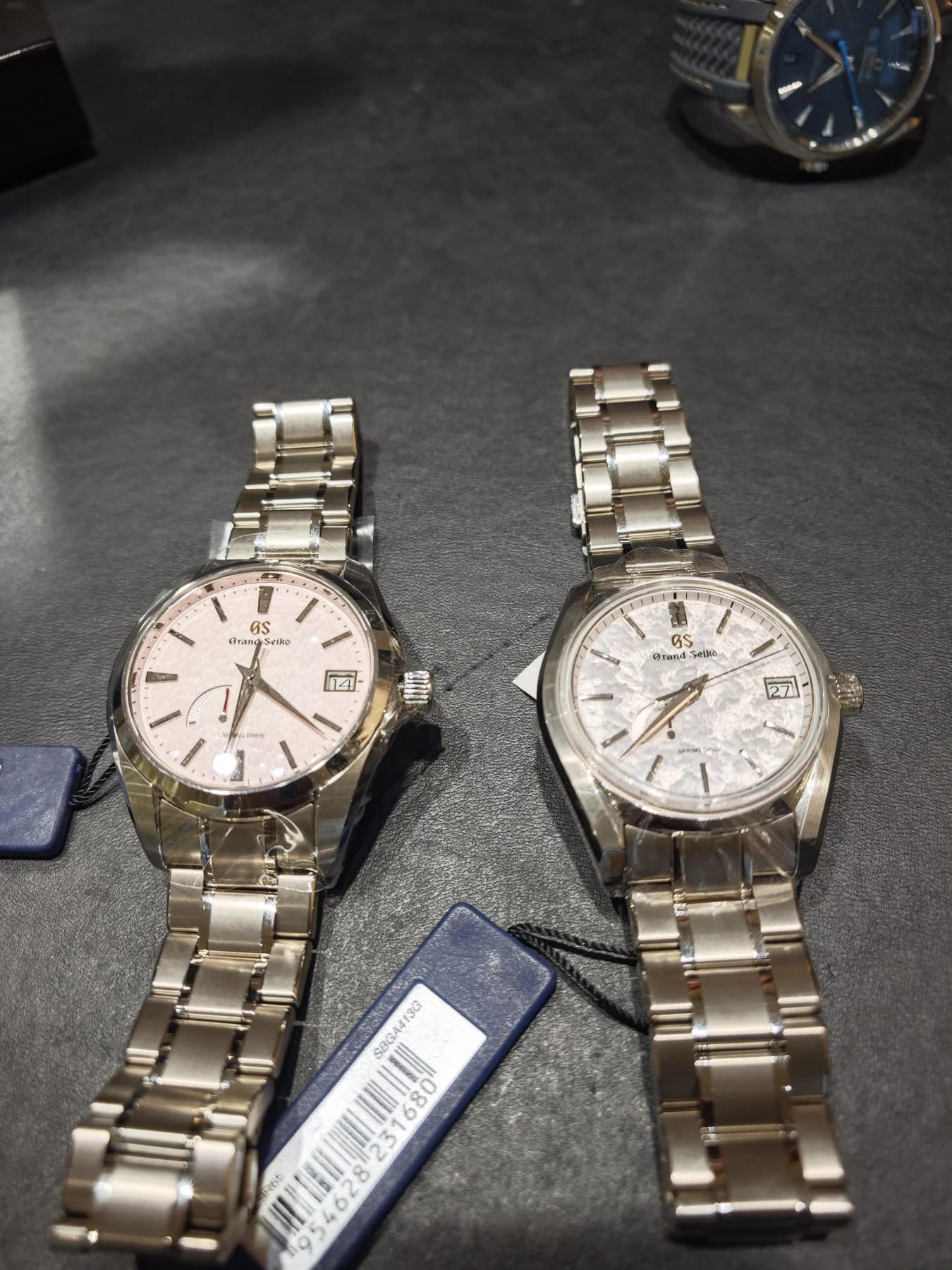
Key differences at a glance
| Consideration | SBGA211 Snowflake | SBGA413 Shunbun |
|---|---|---|
| Case diameter | 41 mm | 40 mm |
| Lug-to-lug | 49 mm | 47 mm |
| Thickness | 12.5 mm | 12.8 mm |
| Case and bracelet | Titanium | Titanium |
| Movement | 9R65 Spring Drive | 9R65 Spring Drive |
| Dial appearance | White texture | Pink-toned texture |
Reference-specific manufacturer measurements, not general specifications for every Snowflake or Shunbun variant. The smaller diameter is not the thinner watch.
Sources: Grand Seiko; Grand Seiko
SBGA211 and SBGA413: compare the actual references
For the familiar SBGA211 Snowflake and SBGA413 Shunbun, the decision is not principally about the movement: both use the 9R65 Spring Drive calibre. The SBGA211 has a white textured dial and a 41 mm case; the SBGA413 has a pink-toned dial and a 40 mm case. These specifications apply to those references, not every watch sharing a nickname.
Both use titanium, but their case outlines and dial effects differ. A one-millimetre diameter difference does not capture the full fit: compare lug span and case profile too. View the pink dial in neutral daylight rather than expecting every photograph’s saturation to match the watch on your wrist.
Sources: Grand Seiko; Grand Seiko
How this applies to Grand Seiko
Ask for photographs in diffuse daylight as well as direct light; textured dials can change dramatically with lighting. Examine polished surfaces for dents and uneven refinishing, and confirm spare bracelet links. Keep a nickname, a reference number and a regional model code separate when matching documents to a listing.
The fit difference is larger than the headline suggests
The SBGA211 measures 49 mm from lug to lug, against 47 mm for the SBGA413; the stated heights are 12.5 mm and 12.8 mm respectively. The smaller-diameter Shunbun is therefore not the thinner of this pair. Consider those dimensions together with where your wrist begins to curve downwards. A watch whose lugs project past the usable top surface of your wrist can feel less settled even if its diameter sounds modest.
The dial comparison also deserves more than a colour preference. Ask for the same watch photographed in neutral light, at an angle and at normal wrist distance. This shows how the texture interacts with the hands and markers rather than only how dramatic it looks in a close-up. For a first purchase, try to resolve case fit before selecting by a favourite dial photograph. For an additional watch, consider whether the white Snowflake or pink-toned Shunbun adds the contrast you actually want in your collection.
Sources: Grand Seiko; Grand Seiko
Put the information to work
Choose on fit and which dial you enjoy in ordinary lighting. Then compare condition, bracelet completeness, service history and the exact regional reference. If you already favour one design, a better-documented example may matter more than a small theoretical specification advantage.
References and further reading
Manufacturer documentation and independent sources behind the details discussed above. Technical specifications apply to the named reference, not automatically to every watch in a collection.