Bvlgari / Watch journal
Bvlgari Octo Finissimo Guide
Octo Finissimo references do not share one universal thinness or water-resistance specification. Compare the geometry, material and actual case construction.
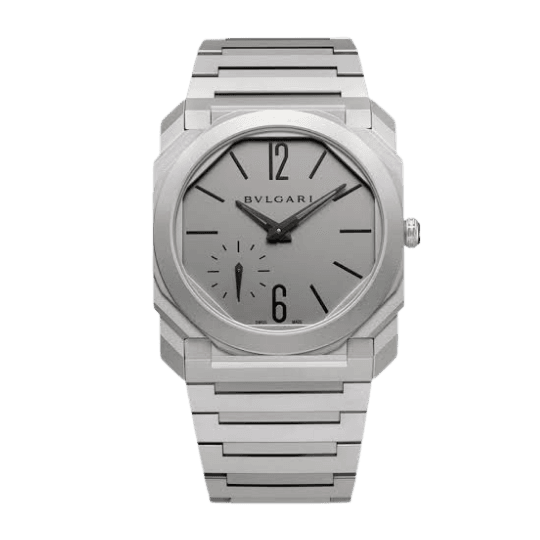
Ultra-thin does not mean one universal specification
Octo Finissimo combines a geometric case with a focus on thinness. As a concrete example, rose-gold reference 102912 uses the BVL 138 automatic calibre and has a stated 5.15 mm case thickness. Other Octo Finissimo references differ; the steel 103431 is listed at 6.4 mm.
Compare the full reference for material, surface finish, thickness and water resistance. A specification from an early thin dress reference must not be applied to every later steel model. The broad case outline also means a thin watch can still cover a substantial area of the wrist.
How this applies to Bvlgari
On a jewellery-led watch, examine bracelet tension, clasp security and any stone-setting work. On an ultra-thin watch, ask about impact history and servicing rather than assuming a slim case is maintenance-free. Material, dial and bracelet must match the reference when comparing seemingly similar offers.
Thinness solves one problem, not every problem
A low case can be welcome under a close cuff, but the Octo’s angular outline still has a substantial visual footprint. Assess it with your normal sleeve and from a natural viewing distance. Then look at how the bracelet turns down around the wrist and where the clasp rests. A comparison based only on millimetres of thickness misses why one thin watch can feel balanced while another sits too broadly for its wearer.
When comparing finishes, ask for close-ups that show edges and changes between surfaces rather than only a uniformly lit dial. Dents and uneven refinishing can alter the architecture that makes the design attractive. Do not borrow water-resistance or crown instructions from another Octo Finissimo because its case looks similar. A reference-level comparison lets you choose deliberately between the materials and constructions instead of buying the broad idea of an ultra-thin watch.
Put the information to work
Inspect case edges, bracelet joints and clasp condition, and obtain the correct operating instructions. Avoid treating thinness as evidence of impact resistance. Ask about servicing and any prior damage; a carefully documented example is a better basis for ownership than a record-thinness headline alone.
References and further reading
Manufacturer documentation and independent sources behind the details discussed above. Technical specifications apply to the named reference, not automatically to every watch in a collection.