Jaeger-LeCoultre / Watch journal
Jaeger-LeCoultre Master Chronograph
Identify the counters, calendar functions and exact Master reference. A running watch is not the same as a fully tested chronograph.
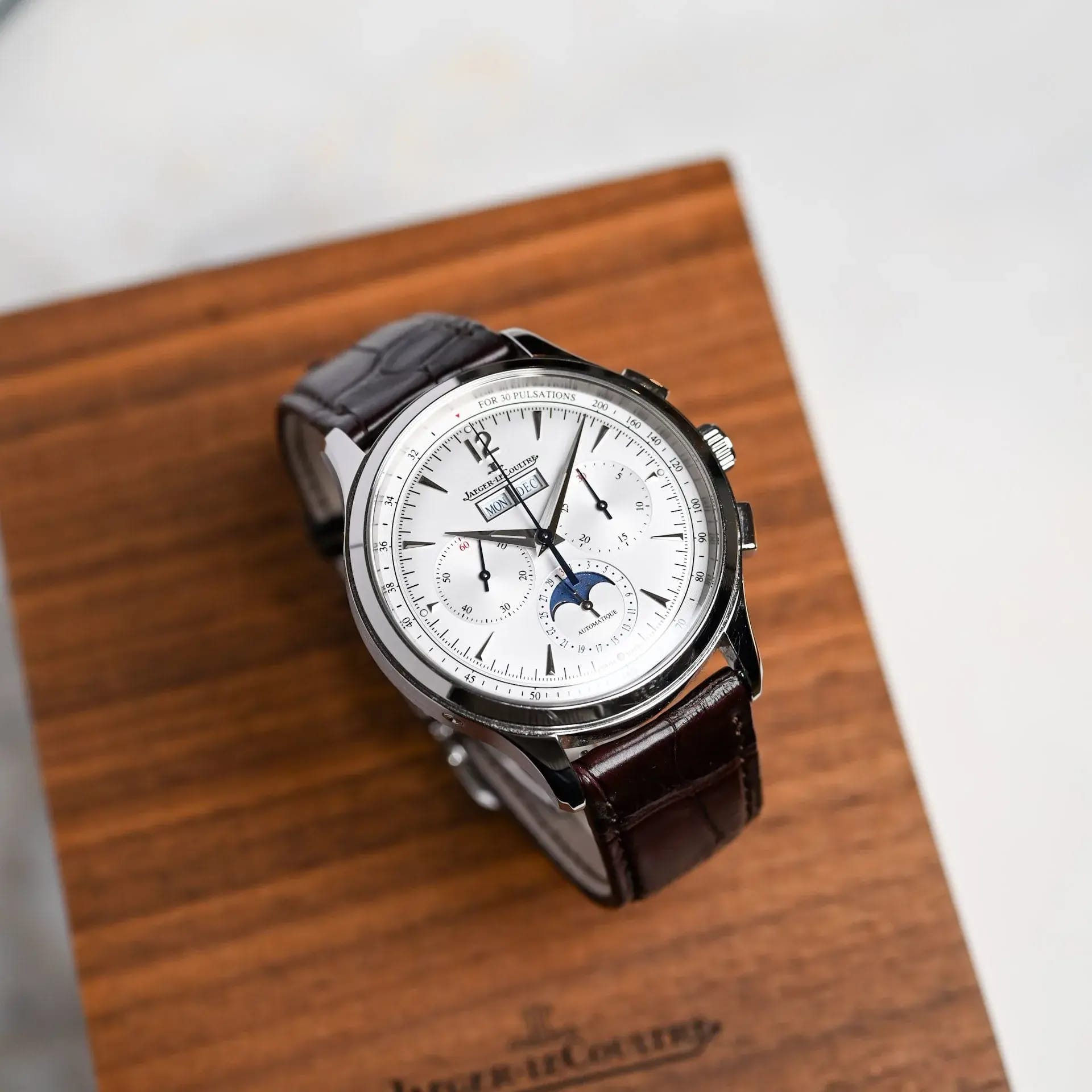
Distinguish the Master reference and its functions
“Master Chronograph” is not enough to identify a Jaeger-LeCoultre watch. Establish the exact Master collection, reference and calibre, then separate a chronograph from calendar or travel-time functions. The dial layout should support how you intend to use the watch, not merely maximise the number of displays.
Testing language also needs a date and reference. Master Control is associated with the manufacturer’s 1,000 Hours Control, while the 2026 Master Control Chronometre generation introduces HPG testing. Do not retroactively attach the newest testing claim to an older chronograph listing.
Sources: Jaeger-LeCoultre
How this applies to Jaeger-LeCoultre
Check the Reverso carrier and locking action, engraving or refinishing on the reverse, and the correct clasp. For complicated models, ask for each function to be demonstrated. Distinguish vintage examples from modern reissues and collection names; an old-looking dial is not proof of an early production date.
An example with more than a stopwatch: Q4138480
The Master Control Chronograph Calendar Q4138480 illustrates why the full reference matters. Jaeger-LeCoultre describes this model with automatic calibre 759, a chronograph, triple calendar and moon-phase display, with a stated 65-hour reserve. It is therefore a different ownership proposition from a simpler watch described loosely as “Master Chronograph”. The additional displays need to be included in the demonstration and service assessment, not treated as decorative details.
Use that example as a method, not a requirement to choose this particular watch: list every displayed function, find the matching instructions and compare how frequently you would use it. Do not describe a triple calendar as perpetual just because day, date and month are all visible. The information on the dial and the logic that advances it are separate specifications.
Sources: Jaeger-LeCoultre
Understand what each display is doing
Before comparing dial colours, identify normal seconds, chronograph seconds and the elapsed-minute or hour counters on the actual reference. A stopped central chronograph hand is not necessarily a stopped watch. Conversely, hands positioned neatly in a photograph do not prove that reset alignment is correct after use. Ask for a short start–stop–reset demonstration and an explanation of any additional calendar displays. This makes it easier to spot a listing that uses a broad collection label instead of describing the watch accurately.
For regular office wear, compare dial space and pusher projection with a simpler Master model before deciding that more information is preferable. For a collector who enjoys using a chronograph, tactile operation and legibility may justify the extra complexity. In both cases, ask whether the last service covered the chronograph as well as timekeeping. The relevant question is not only whether the watch runs, but whether every mechanism you are paying for works as intended.
Put the information to work
Request operation of start, stop and reset, plus any calendar functions, by a person familiar with the calibre. Compare case thickness and pusher comfort under a cuff. A complication that is rarely used still requires maintenance, so include servicing in the decision rather than considering the purchase price alone.
References and further reading
Manufacturer documentation and independent sources behind the details discussed above. Technical specifications apply to the named reference, not automatically to every watch in a collection.