Bvlgari / Watch journal
Bvlgari Serpenti Watch
Bracelet construction and wrist fit come first with Serpenti. Assess the jewellery design and timekeeping mechanism as two parts of one purchase.
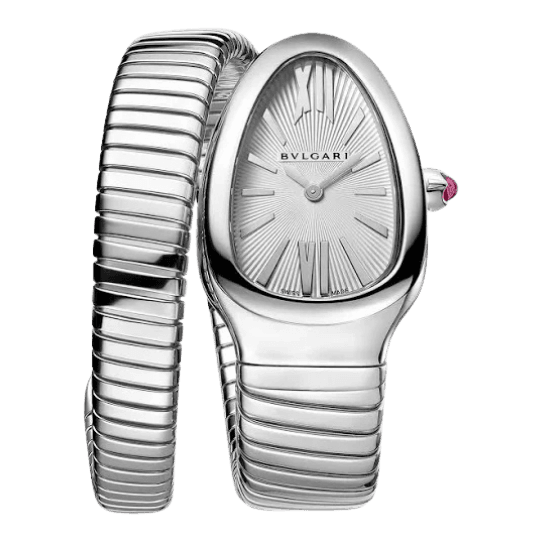
A bracelet-led watch must fit before anything else
Serpenti is a design family, not one bracelet or movement specification. Bvlgari’s Tubogas watch history reaches back to 1948, but modern Serpenti references use different constructions, materials and mechanisms. Begin with the exact design and wrist size rather than assuming every example wraps or adjusts in the same way.
A jewellery-style watch should be assessed for comfort and security as well as dial condition. Ask for the intended wrist-size range, the number of wraps where relevant, clasp operation and a complete description of stones or later alterations. Do not categorise every Serpenti as quartz; check the actual reference.
Sources: Bvlgari
How this applies to Bvlgari
On a jewellery-led watch, examine bracelet tension, clasp security and any stone-setting work. On an ultra-thin watch, ask about impact history and servicing rather than assuming a slim case is maintenance-free. Material, dial and bracelet must match the reference when comparing seemingly similar offers.
Assess the bracelet and the watch separately
With Serpenti, the bracelet is not just a way of attaching a conventional watch to the wrist; it is central to the design. View the piece from the side and underneath as well as face-on. Ask how it opens, how it settles on the intended wrist and what size adjustment is possible for that exact construction. A photograph that shows a dramatic coil does not tell you whether the ends sit securely or whether the piece has been altered.
Then evaluate timekeeping on its own terms. Confirm whether the reference is quartz or mechanical and request appropriate function and service evidence. Where stones are fitted, establish whether the setting belongs to the original configuration or a later alteration; photographs alone should not be treated as a gemmological report. For a gift, discreetly establish wrist size before choosing. A slightly different reference that fits correctly is more useful than a visually preferred piece that requires uncertain or irreversible modification.
Put the information to work
Request close-ups of areas that flex and touch the wrist. Confirm what adjustments are possible and whether they need a specialist. Choose fit over an attractive photograph: a watch that is too loose, too tight or altered to fit someone else may require more than an ordinary strap change.
References and further reading
Manufacturer documentation and independent sources behind the details discussed above. Technical specifications apply to the named reference, not automatically to every watch in a collection.